Specialised information services
FID-network – a reliable partner for science and research
Over recent years, we have significantly expanded collaboration within the FID network (Specialised Information Services Network) as a unified system. This robust structure ensures the coordinated development of the FIDs in terms of both content and technology. The aim is to create transparent, interoperable services that are optimally aligned with the needs of the research community. Management of the network is overseen by the FID Steering Committee (FID-LG), which includes representatives from the supporting institutions. Together with the FID Working Group (AG FID), comprising project leaders and subject-specific representatives from the institutions, the FID Steering Committee steers the network's strategic direction and ongoing development.
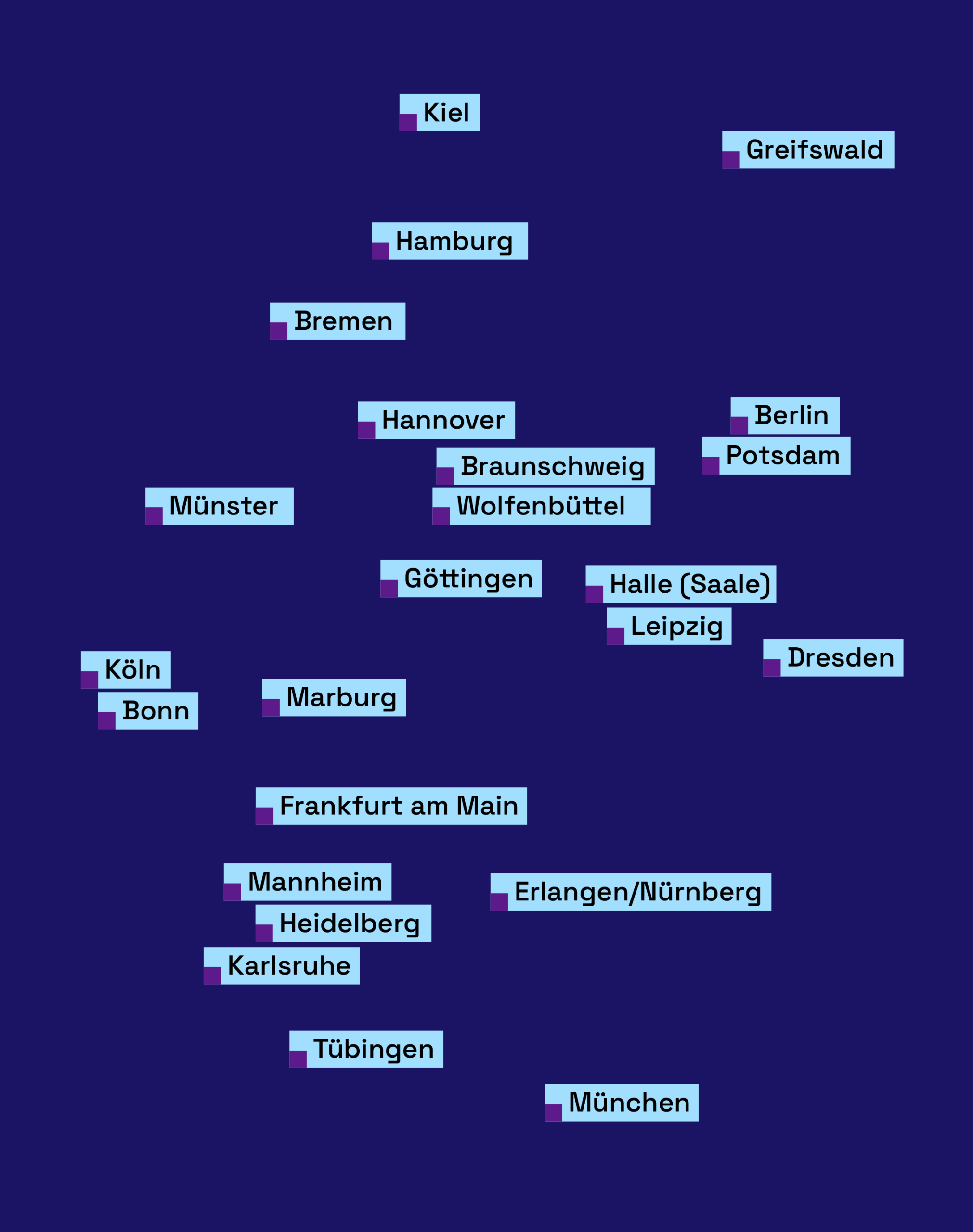
Diversity and individuality
Within the FID network, the diversity of FID is transformed into a strong, cohesive entity: a system in which work is partitioned and distributed, and which is interconnected with distributed focal points. Key principles include common standards, widely used services, and especially the interoperability and reusability of technologies, which enhance utility and improve the network's overall performance. Closer collaboration among all FIDs generates greater added value for everyone, tapping into the collective potential to develop a connected FID network. The DFG requires the individual contributions of each FID to this interconnected system to be clearly demonstrated in applications for long-term funding of Fachinformationsdienste, emphasising alignment with scientific needs and the added value over basic services.
Traditionally up to date
The FID network aims to continue the long-standing tradition of providing scientific literature and information cooperatively in Germany. Its origins in regional and decentralised literature supply date back to the early 20th century, and its structural foundation in the Federal Republic of Germany was established in 1949 with the first DFG Special Subject Collections Plan. Following the 2019 programme evaluation conducted by the DFG and the subsequent process of self-organisation, the network of Fachinformationsdienste (FID) was further developed as a comprehensive structure. Further information: Transfer of Special Subject Collections to the "Discipline-Specific Information Services" Programme | DFG
Focus: Standards
The FID network aims to operate more efficiently and economically within this framework by coordinating, transparently and sustainably, the division of tasks, while facilitating interdisciplinary use through unified standards. The principle of subsidiarity is applied, with the design of individual Fachinformationsdienste primarily guided by the needs of their respective disciplinary communities. Where they are meaningful in terms of content, technical feasibility, and economic efficiency, shared standards and services are developed.
Strategy and FIDplus
The first strategy paper for 2022–2024, developed by the FID-LG and the AG FID, marked the first roadmap for network development and was endorsed by the Committee on Scientific Libraries and Information Systems (AWBI). Key points included raising the profile of the FID network as a unified system, strengthening collaboration within the FID network, and improving coordination in technical and infrastructural areas. To this end, the Technology Board was established to examine infrastructures and technologies for reusability and synergy potential, and to drive further developments. Based on the 2022–2024 action plan, the FID network has established a joint agenda for 2026–2028. This agenda emphasises dialogue with the scientific community and its organisations, collaborative development of standards and services, and fostering innovation, interoperability, knowledge exchange and technology transfer. The action plan also supports the launch of FIDplus (The “Discipline-Specific Information Services” Programme | DFG) and provides a foundation for the DFG’s planned evaluation of this funding line.
Focus: Collaboration
The FID network, which has expanded in recent years to form a comprehensive structure, ensures the coordinated conceptual, content-related and technical development of the FID. The aim is to establish an organisation of interoperable services that is optimised in terms of both content and technology. Management of the FID network is carried out by the Steering Committee (FID-LG), which comprises the leadership of the institutions supporting the FID. This is supplemented by cooperation with the FID Working Group (AG FID), in which project leaders and subject-specific personnel from the institutions collaborate.